

Genesis 11:1-9
- Pastor Wyatt Miles

- Jun 24, 2020
- 8 min read
Bible Study Lesson for June 24
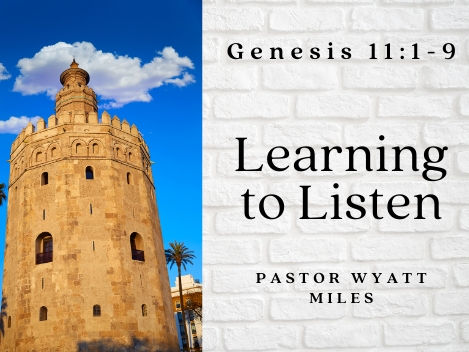
Usually on Wednesday nights, some in our community get together to share prayer requests, we pray together, and I bring a Bible lesson for them. Last week, we covered Genesis 10 so I will pick up today where we left off beginning with chapter 11.
First I’d like to talk about prayer requests. Online communication being what it is, I would rather not get into specific requests in this space, and will leave that for the more private communications that the church has with each other. But I do want to remember a few general prayer requests:
-our government, those making decisions on our behalf
-those in the medical community
-those in food service, grocery stores, and other essential businesses
-those in other businesses that are opening and preparing to open
-teachers and students still figuring out what the closures of schools means for them -prisoners and prison guards
-first responders
-those whose life and income has been disrupted by the current crisis.
I also want to remember all of those suffering from Covid-19 and the communities that it is affecting, including our own.
In addition to these, let’s also pray for everyone involved with demonstrations around our country and the world.
-protesters
-police
-government officials
-hospitals
-reconciliation
Take a moment to pray for these folks now before we begin.
Genesis 11:1-9
The story of the Tower of Babel marks the end of the beginning of humanity’s story. This story is the last story in the Bible to treat all humans as one unified whole. It is a familiar story, partly because it is brief, partly because it is dramatic, and partly because it is the last universal crisis in the first part of Genesis. After this, the narrative will begin to have a laser focus on one man, one family, one nation. By the end of chapter 11, we will have met Abram, through whom God will promise that all the nations will be blessed (12:3). But first, we have this story.
The story of Babel on one level explains how different languages came to exist. It answers a question: if all the nations are descended from the family of Noah, why do we speak differently? The diversity of human language is something of a tragedy, because it limits our ability to understand one another. I will never forget the first time I went to Washington, DC on a family vacation, and as we were looking around at monuments and museums, I was surprised to hear people speaking in many different languages. Something about that day, perhaps the mood I was in, made me feel limited: I couldn’t speak to these people. We couldn’t be friends.
But a close reading of the Babel story in the context of Genesis 1-11 will give us a deeper insight. This story about the confusion of language is also about human rebellion and the will of God. We see the scattering and confusion of languages as a punishment of God. But they are also the means by which God brings about the fulfillment of human obedience to the first command of God: to fill the earth (Genesis 1:28).
When we started studying Genesis, I asked you to remember two questions: Why are you here? And what is your problem? In Genesis 1:28, we find a preliminary answer to the first question: God gave humanity a job to do: “Be fruitful and multiply, fill the earth and subdue it; and have dominion over . . . every living thing that moves upon the earth.” It will be important to bear this command in mind as we look closely at the story of the Tower of Babel.
V. 1-2 Setting
At this point in the story, we are a few generations removed from the flood. I believe for the narrative to make sense we have to set it in the middle of the genealogies of the previous chapter. Perhaps this story is set in the days of Peleg, in whose “days the earth was divided” (Genesis 10:25). This would also make sense of the next genealogy’s placement. Right after the Babel story we have a second genealogy starting with Shem, but this one continues to trace Peleg’s family line down to Nahor (11:22), Terah (11:24), and finally Abram (11:26). But no characters other than God are actually named in the Babel story, and so it seems to be an interruption of the genealogies of chapter 10 and 11:10 and following.
When the story begins, we see humans sharing one language and traveling together. In verse 2 they settle on a plain in the land of Shinar.
V. 3-4 Humanity’s goals
Verse 3 describes a technological innovation - making bricks. The people proceed to plan to make a city on the plain with a high tower in the middle of the city. All of this is presented in logical order: bricks, city, tower.
But why do they want to do this? One thing is to “make a name for ourselves.” This is a common way to talk about reputation, then as now. But it also is a question of unity and identity. They are attempting to prevent being separated: “otherwise we will be scattered abroad upon the face of the whole earth.” Now this is a fascinating turn of events. It seems within this story that humanity has up to this point been traveling together. And once they find the plain of Shinar they think they can stop, settle, and live together.
But remember what God’s plan for humanity is: “to fill the earth.” The type of unity that the people want, a unity found in living in the same place, a unity of shared cultural and architectural achievement, is a unity that flies directly in the face of the command of God. They cannot fill the whole earth while staying in Babel.
Why a tower? There is something about a tower that symbolizes unity pretty well. In the 19th and early 20th centuries, architects began figuring out how to build taller and taller structures and there was a period where almost every year a taller building was being built. Part of it was the fact that the cost of property in cities began to skyrocket and so owners of property needed to maximize their profits by putting more people on an acre of land. As we are learning in this age of social distancing, people take up a certain amount of horizontal space, but once you add a vertical dimension, the sky is literally the limit.
By the middle of the 1900s, a city of any size needed a skyline with at least one tower. In Waco, Texas, where I used to live, the old downtown had been destroyed by a tornado in 1953 and only one tall building was left standing. The Alico Building was built in 1906 and stood 22 stories. It’s by no means a skyscraper, but it is the first thing you see when you are driving into Waco on a clear night. I was surprised to learn that there were natives of Waco who have seldom, if ever, moved out of sight of the Alico Building. Surrounded as it is by a wide swath of flat land, the tower serves as a landmark: as long as you can see that tower you will never be lost; you can always find your way back to Waco. Perhaps that’s what humanity was after at Babel. Perhaps they wanted, above all else, a landmark they could be proud of. Maybe it was something they could rally around.
V. 5-8 God’s response
I love the way Genesis talks about God: “The Lord came down to see the city and the tower . . . .” Just like in the creation story, the story of the fall, and of Cain and Abel, God comes to look, to inspect closely, the work of humans. God in the Bible is not always the impersonal God who just knows things. God enters into our stories in order to invite us into the story that God is trying to tell. God’s story will ultimately triumph over every other story.
God comes and sees what the humans are up to. And God sees in the type of unity the humans are seeking a rebellion. God sees that if things continue without a change, humans will be able to forge their own way. We have already seen that this results in a rejection of God’s purpose in their refusal to scatter over the earth.
In verse 7, your Bible probably says that God’s purpose in confusing human languages is “so that they will not understand” each other when they talk. The Hebrew word used there is the word shema, which can mean to listen, hear, or obey. This conveys a slightly different idea than “understanding,” and I think it speaks to our time. Our problem isn’t so much that we can’t “understand” each other, as it is that we can’t even “listen to” each other. Listening to one another requires effort. When we find we can’t understand something or someone, we often have a desire to tune them out. And so maybe we think, well I haven’t heard anything from that person, so they must not have anything to say.
Author Gary Chapman deals with this idea in his book The Five Love Languages, where he finds that individuals tend to give and receive love in one or two of five distinct ways. He identifies physical touch, quality time, words of affirmation, gifts, and acts of service as the five basic ways that people give love. One of the problems that this creates is when people don’t understand the idea of different love languages, they can’t hear someone else’s “I love you” or else they can’t say “I love you” in a way that the other person can hear it. This most important message needs to be spoken in a way that it can be heard.
V. 9 Conclusion
And so it was as God says. The people no longer speak the same language and are scattered all over the earth.Typical of the Genesis story, we have an origin for a place-name that comes out of the story. Babel means confusion, because now all the people can hear from each other is so much babbling.
What can we glean from this story? I think one temptation is to think that God wants to keep us apart from each other. This is obviously not the purpose of the story in the wider context of the Bible. Instead, we need to be aware that not all projects for unity are good. The unity God has in mind for humanity comes from a deep relationship and covenant with God. Most of our human projects for unity revolve around imposing unity on other people, whether that means forcing them to behave in particular ways or just calling on them to live in a particular place.
God wants humans to spread out and from a cultural perspective this will always result in diversity. As humans moved to new places with new climates and natural resources, they encountered different needs in different places and began to talk, dress, think, and act in different ways. This is one of the reasons languages don’t correspond to one another in one-to-one ways. As I mentioned, in Hebrew the word shema can be translated to mean understand, hear, listen, or obey, among other options. In English these words are related, but we certainly wouldn’t use them interchangeably. Another famous example is that ruach in Hebrew can mean wind, breath, or spirit. The language we use impacts and is impacted by how we understand the world. Diversity of location breeds diversity of language.
What unity is available to us then? As I said, it has to be a unity found in relationship with God. One of the ways God creates unity among us is by fostering humility in the people of God. Because of what I just said about location influencing language, we need to always remember that our perspective on the world is not neutral. There is no perspective free of bias and all perspectives are affected by language. One of the problems with talking about God is that our language can’t contain all of God’s truth. We have to remember that we are pointing at God with our words, but that we cannot offer a definition of God.
Finally, the crisis of Babel is traditionally understood to be resolved by the miracle of Pentecost, where all of the disciples speak in the languages of the nations gathered in Jerusalem. Walter Brueggemann points out that the Acts 2 text emphasizes that the nations can “hear” the disciples speaking in their language. Understanding, especially across cultures, is the work of God in the Holy Spirit. God unites us, not by giving us some overriding language that everyone must learn, but by allowing us to hear each other. Will you listen?


Comments