

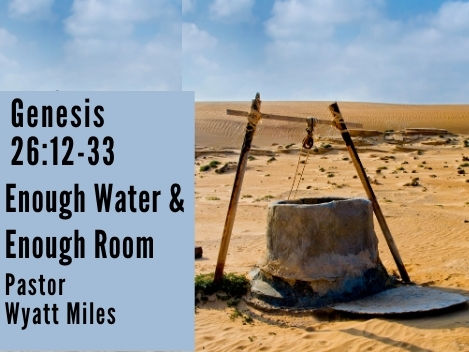
Enough Water & Enough Room - Genesis 26:12-33
- Pastor Wyatt Miles

- Feb 10, 2021
- 4 min read
Bible Study Lesson for February 10
Our story opens with a familiar scene like a Western movie: two cowboys walk out into a dusty street and one spits on the ground and says to the other, “This town ain’t big enough for the two of us.” The camera cuts between their eyes and their hips; their hands inch closer to the pistols hanging from their belts. And then, somehow seconds later and also after an eternity, there is an explosion of movement, a flash of gunfire, as smoke rises from gun barrels and one of the cowboys falls to the ground. “This town ain’t big enough for the two of us.” There is something about the human condition that makes us believe in scarcity. In Genesis 26, Isaac’s blessing is perceived as a threat by his neighbors because they believe that his blessing must somehow come at their expense.
In this chapter, we get a picture of Isaac’s agricultural empire. He grows plants (v. 12) and oversees herds of animals (v. 14, 20). His abundance and the quality of his harvests causes the Philistines among whom he lives to envy him. Abimelech asks him to leave the area to prevent him from overrunning Gerar and the surrounding land. Perhaps the king wants to see if it is the land that Isaac is farming that is blessed. When Isaac leaves, however, it becomes clear Isaac himself is the one who is blessed.
Isaac’s main activity in this passage is digging wells. Actually, Isaac re-digs the wells that his father Abraham had dug and the Philistines had stopped up. Commentators see this as an act of pettiness on the part of the Philistines; ultimately it would hurt them and the family of Abraham to bury the source of water. Isaac does not inherit these wells from his father. Instead, he works hard to dig them out himself and has a higher stake in the wells and the heightening conflict between him and the Philistines. Water in the Ancient Near East was hard to come by, and so it is natural that the Philistines would quarrel with Isaac over the water he has secured access to. Walter Brueggemann points out that Isaac’s wells heighten the tension over his inheritance that Jacob and Esau will fight over, because a well is an inheritance that is not easily divided. Just as the idea of scarcity divides Isaac from his neighbors, it will also divide his sons from each other, until one of them realizes that there is room enough for both of them.
Isaac digs two wells that the Philistines take away from him before finally digging one where he is left to live in peace. He calls this well Rehoboth, meaning “broad places.” Much of human existence is the quest for “broad places,” the search for enough room to spread out. In the twentieth century, Adolf Hitler’s foreign policy was driven by a quest for “lebensraum” or “room for living.” He believed and argued that the German people needed and deserved to expand, but the problem was that all the areas around them were occupied. His teaching about a master Aryan race became the justification for German expansion at a tremendous cost of life and war to all those around. At every stage Hitler tried to convince the other world powers that this expansion was the last one, but the quest for enough room always meant a need for a little more. Eventually the invasion of Poland triggered the start of World War II. The quest for “enough,” left unchecked, becomes a quest for “more,” and it affects everyone.
In his Pulitzer Prize winning history The End of the Myth, Greg Grandin tells the story of American expansion by looking at American ideas about the frontier. For the first 150 years of American democracy, growth seemed inevitable and limitless because of the supposedly empty Western frontier. As settlers crossed the Appalachian Mountains, and then the Mississippi River, and pushed further West across the Rockies and to the Pacific, there was a constant “pressure valve.” Any time Western cities began to get crowded, folks would push a little farther to the West. When they encountered the Indigenous people already living on the land, the settlers saw them as in the way. They pushed the Indigenous people to smaller and smaller pieces of land and killed many of them in the process. The emptiness of the land was itself a myth and one that couldn’t last. Since the 1920s, the Western Frontier has basically filled with people, and the United States has begun to feel crowded. Like Abimelech, we are tempted to make room for ourselves by expelling the Isaacs in our way. Like Abimelech, this story from Genesis invites us to find a better way.
At the end of the current reading, Abimelech comes to Isaac, bringing along his inner circle of advisors. Abimelech and his advisors and Isaac make a covenant together, establishing a peaceful relationship at last. In relationship, we can find our needs met without having to control the other party. We can move from an economics built around scarcity towards what some authors call a “theology of enough.” We can own the well without hoarding the water. We can allow our neighbors to prosper without fearing that in their prosperity we will be left behind. This story, and the Bible itself, leads us from a posture of competition based in an assumption of scarcity to a posture of cooperation based in a theology of enough. One of the purposes of our ministries is to rewire our brains so that we can see our life together as cooperation instead of competition. We share our time and our excess in repurposing extra blue jeans into shoes and extra grocery bags into sleeping mats. We share in the Blessing Box when we have extra nonperishable foods, in faith that if we find ourselves in need down the road, folks will contribute so that we also might eat. These types of ministries help to move us from jealousy and strife to a recognition of God’s ability to bless others, and in God’s blessing of them, we may also be blessed.


Comments